• Home
  • IDEAS
  • GROUPS
    • Classical German Philosophy and Phenomenology
    • The quarrel between the ancients and moderns
    • The quarrel between philosophy and poetry
    • Theories of Emotions
    • Philosophies of Image and Imagination
    • Utopia, the Political Myth, and Rebellion
    • The Philosophy of Nature
  • EVENTS
  • PEOPLE
  • ADMISSION
  • CONTACTS
  • CONFERENCES
    • 2016
      • Il tragico nella letteratura tedesca
      • Dialectic and the Ends of Reason
        • Schedule
    • 2015
      • CONVEGNO MELANCOLIA
        • Introduction
        • Schedule
      • CONFERENCE ON THE ANCIENTS
        • Introduction
        • Schedule
      • Immaginazione e Giudizio In Kant
        • Schedule
    • 2014
      • Hegel and the phenomenological movement
  • ODRADEK Journal

Author Archives: Danilo Manca

Utopia, mito politico e simboli della libertà

28 Thursday Sep 2017

Posted by Danilo Manca in seminari

≈ Leave a comment

Tags

Baczko, Benjamin, Bruto, Chiara De Cosmo, Danilo Manca, escatologia, filosofi-re, Goethe, Guido Frilli, Hobbes, Hybris, immaginario sociale, legge civile, legge naturale, Marta Vero, mito politico, Nicoletta Gini, platone, politica, Prometheus, simboli della libertà, utopia, Valentina Serio

Con piacere segnaliamo il seminario di studi organizzato dall’Istituto italiano di Studi Filosofici in collaborazione con Zetesis sul tema “Utopia, mito politico e simboli della libertà”, che si terrà a Napoli fra 11 e 12 dicembre. Per chiunque voglia partecipare attivamente sono previste delle borse di studio. Sui dettagli si legga la seguente locandina:

Share this:

  • Email a link to a friend (Opens in new window) Email
  • Share on Facebook (Opens in new window) Facebook
  • Print (Opens in new window) Print
  • Share on X (Opens in new window) X
Like Loading...

Workshop: Concepts, Intuitions and ‘Manifest Reality’, Padua 11-12 september

07 Thursday Sep 2017

Posted by Danilo Manca in suggerimenti eventi

≈ Leave a comment

Tags

Anna Tomaszewska, Anselmo Aportone, Barbara Santini, concepts, Dietmar Heidemann, Francesca Menegoni, Gabriele Tomasi, Gregorio Demarchi, intuitition, Kant, Lorenzo Cammi, Luigi Filieri, manifest reality, Manja Kisner, Sabrina Bauer, Sebastian Rödl

Con piacere segnaliamo il seguente workshop:

Concepts, Intuitions and ‘Manifest Reality’

Workshop, September 11th-12th, 2017 Sala Diano – Palazzo Liviano


Monday, September 11th

Session I: Chair Gabriele Tomasi

9.30: Welcome: Francesca Menegoni (Coordinator of the PhD Program in Philosophy), Gabriele Tomasi (Coordinator of the Kantian Seminar)

10.00: Lucy Allais (UC San Diego): The Compatibility of Kantian Determinism with an Open
Future

11.30: break

11.45: Anna Tomaszewska (JU Krakow): The Theological Motivations of Kant’s
Transcendental Idealism


Session II: Chair Davide Dalla Rosa

14.30: Anselmo Aportone (Università di Roma Tor Vergata):Sintesi estetica e facoltà cognitive

15.45: break

16.00: Sabrina Bauer (Universität Heidelberg): Die Unerkennbarkeit der Dinge an sich im transzendentalen Idealismus

16.45: Lorenzo Cammi (Università di Verona): The Thing in Itself as the Thing Full of Powers. A Dispositional Interpretation


Tuesday, September 12th

Session III: Chair Anselmo Aportone

9.30: Dietmar Heidemann (Université du Luxembourg):Non-Conceptualism and Aesthetic Cognition in Kant

10.45: break

11.00: Barbara Santini (Università di Padova): Regel der Synthese und Gegenstandsbezug mit Rücksicht auf die Analytik der Grundsätze
11.45: Luigi Filieri (Università di Pisa): Intuitive Synthesis and Conceptual Unity: Kant on the Synthetic Import of Sensibility


Session IV: Chair Elena Tripaldi

14.30: Sebastian Rödl (Universität Leipzig): Kant’s Indirect Proof of Transcendental Idealism

15.45: break

16.00: Manja Kisner (LMU München): Kant’s Twofold Conception of the Transcendental Idealism

16.45: Gregorio Demarchi (Friedrich-Schiller-Universität Jena): Kants Kritik am Prinzip der Identität der Ununterscheidbaren

download flyer here
download program here
 

Contacts:

gabriele.tomasi@unipd.it

elena.tripaldi@studenti.unipd.it

davide_dallarosa@studenti.unipd.it

barbara.santini@unipd.it

Share this:

  • Email a link to a friend (Opens in new window) Email
  • Share on Facebook (Opens in new window) Facebook
  • Print (Opens in new window) Print
  • Share on X (Opens in new window) X
Like Loading...

Odradek volume on Denkbilder is out

25 Tuesday Jul 2017

Posted by Danilo Manca in Odradek

≈ Leave a comment

Tags

Auschwitz, Camilla Passigli, Danilo Manca, Didier Alessio Contadini, Elias Canetti, Ernst Bloch, Francesco Rossi, Franz Kafka, G. W. F. Hegel, Günther Anders, Giancarlo Lacchin, Harald Zils, Herta Müller, Isabella Ferron, Maximilian Herford, Micaela Latini, Peter Koenig, Plato, platone, Raul Calzoni, Robert Walser, Silvia Vezzoli, Stefan George, Stefano Beretta, Takaoki Matsui, Theodor W. Adorno, W. G. Sebald, Walter B. Pedriali, Walter Benjamin

We are glad to announce that the fourth volume of International Journal ODRADEK is out!
The issue n. 2 (2016) is entitled Denkbilder. «Thought-Images» in 20th-century German Prose. Editors are Prof. Raul Calzoni (Università degli studi di Bergamo) and Prof. Francesco Rossi (Università di Pisa).
In order to read the articles, please log in here

TABLE OF CONTENTS

Instead of an Introduction: Towards a Definition of the Denkbild
Raul Calzoni, Francesco Rossi

ARTICLES
Denkbild: storia, arte e filosofia. George, Platone e la “poetica delle idee”
Giancarlo Lacchin

L’immagine-pensiero come Aufhebung del pensiero concettuale di Hegel?
Danilo Manca

Zu Walter Benjamins „Denkbildern“
Peter Koenig

Die Weisheit im Exil: Gewalt, Mythos und Geschichte in Walter Benjamins Tiergarten
Takaoki Matsui

Villes et images. Possibilités actuelles du Denkbild
Didier Alessio Contadini

Cornici di parole: “Spuren” di Ernst Bloch
Micaela Latini

Betrachtung. Le immagini-pensiero di Franz Kafka
Francesco Rossi

La maschera della Gorgone: Günther Anders interprete dei Bilder kafkiani
Camilla Passigli

Überlegungen zu einer Poetik des Kleinen in Robert Walsers Kurzprosa
Maximilian Herford

La scrittura della metropoli per immagini nelle prose berlinesi di Robert Walser
Stefano Beretta

Ernst Jünger und das Denkbild als konservative Erkenntnispraxis
Harald Zils

Towards a Topography of the Void. Adorno on Silence and Other Extremal Denkbilder
Walter B. Pedriali

Walter Benjamin, Th. W. Adorno, W. G. Sebald e il “Denkbild nach Auschwitz”
Raul Calzoni

“Ich bekam ein Puzzle zum Geschenk”. Denkbilder bei Elias Canetti
Isabella Ferron

Herta Müller: una poetica del Denkbild?
Silvia Vezzoli
 

Share this:

  • Email a link to a friend (Opens in new window) Email
  • Share on Facebook (Opens in new window) Facebook
  • Print (Opens in new window) Print
  • Share on X (Opens in new window) X
Like Loading...

Volume on “The Wisdom of the Ancients” is out!

17 Monday Jul 2017

Posted by Danilo Manca in Senza categoria

≈ Leave a comment

Tags

Anna Romani, Antiquity, Aristophanes, Catherine Zuckert, David Janssens, disputa fra antichi e moderni, Eduardo Zazo Jiménez, Elad Lapidot, Fabio Fossa, Ferdinand Deanini, filosofia politica, German Philosophy, Gnosticism, hannah arendt, Hans Jonas, historicism, history of science, Iacopo Chiaravalli, Jacob Klein, Jewish Studies, Karl Löwith, Kuzari, Leo Strauss, Luca Timponelli, Marco Menon, Marco Sgarbi, Modernity, natura, nature, Nietzsche, Philipp von Wussow, Plato, Political Philosophy, Quarrel between Ancients and Moderns, Roots, Socrates, storia della scienza, storicismo

The volume “The Wisdom of the Ancients. The German-Jewish Revaluation of Ancient Philosophy”, edited by Fabio Fossa and Anna Romani, is now out!
It is readable on the website of the International Journal “Philosophical Readings” (editor in chief: Prof. M. Sgarbi) on the following link: https://zenodo.org/record/826367#.WWyc5f_ygza

Here the Table of Contents:

Platos’ Republic: The Limits of Politics

Catherine H. Zuckert …………………………………………………………………………1

A Lesson in Politics: Some Remarks on Leo Strauss’ Socrates and Aristophanes

Marco Menon …………………………………………………………………………6

Plato, Arendt and the Conditions of Politics

Luca Timponelli……………………………………………………………….12

Leo Strauss on Returning: Some Methodological Aspects

Philipp von Wussow…………………………………………………………………..18

Back to the Roots. The Correspondence Between Leo Strauss and Jacob Klein

David Janssens…………………………………………………………………25

Repetition of Antiquity at the Peak of Modernity as Phenomenological Problem

Iacopo Chiaravalli………………………………………………………………31

Progress as a Problem:

Strauss and Löwith in Dialogue between Antiquity and Modernity

Anna Romani ………………………………………………………………………..37

Naturalness and Historicity:

Strauss and Klein on the Quarrel between the Ancients and the Moderns

Danilo Manca…………………………………………………………………..44

Löwith’s Nietzschean Return to the Ancient Conception of Nature

Eduardo Zazo Jiménez ………………………………………………………………………..50

Ancient Wisdom and the Modern Temper. On the Role of Greek Philosophy and the

Jewish Tradition in Hans Jonas’s Philosophical Anthropology

Fabio Fossa …………………………………………………………………..55

Hans Jonas’ Work on Gnosticism as Counterhistory

Elad Lapidot………………………………………………………………….61

The Law and the Philosopher. On Leo Strauss’ “The Law of Reason in the Kuzari”

Ferdinand Deanini …………………………………………………………………69

Share this:

  • Email a link to a friend (Opens in new window) Email
  • Share on Facebook (Opens in new window) Facebook
  • Print (Opens in new window) Print
  • Share on X (Opens in new window) X
Like Loading...

NEW ODRADEK CFP: PHILOSOPHUS RIDENS

24 Saturday Jun 2017

Posted by Danilo Manca in CFA-CFP, Odradek

≈ Leave a comment

Tags

Bergson, comedy, commedia, Freud, Hobbes, Kant, laughing philosopher, Laughter, laughter as social phenomenon, Nietzsche, psychology of laughter, riso

CALL FOR PAPERS

Philosophus ridens

ODRADEK

Studies in Philosophy of Literature, Aesthetics and New Media Theories

 Odradek. Studies in Philosophy of Literature, Aesthetics and New Media Theories is an International Journal (http://zetesis.cfs.unipi.it/Rivista/index.php/odradek/index) founded by Zetesis (www.zetesisproject.com) Research Group on the Quarrel between Philosophy and Poetry. Zetesis is a Research Center related to the University of Pisa History, Philosophy, and Arts Department.

 The Journal publishes in online version powered by Open Journal System (OJS)

ISSN: 2465-1060

 Section Editor: Leonardo MASSANTINI
(University of Pisa), leonardomassantini@gmail.com

 Authors are cordially invited to submit papers for the upcoming edition of the Journal that will deal with Philosophus ridens

 Submission deadline: 2nd November 2017

Language: English, German, Italian, French, Spanish, Portuguese.

The paper can be submitted online via OJS – Open Journal System:

http://zetesis.cfs.unipi.it/Rivista/index.php/odradek/index

 Authors can find submission guidelines at the following link:

http://zetesis.cfs.unipi.it/Rivista/index.php/odradek/about/submissions#onlineSubmissions

 All papers will be reviewed according to our peer review process policy:

http://zetesis.cfs.unipi.it/Rivista/index.php/odradek/about/editorialPolicies#peerReviewProcess

For any further detail or information please feel free to contact the section editor at:

Laughter is a familiar experience generally connected with joy. At the same time, it is a puzzling phenomenon with which philosophy has had an ambiguous relationship. Relatively few thinkers have tackled this subject, as many of them considered it a problem of secondary importance. Even those who have written about it, especially in the past, have often described it as a malicious manifestation, typical of the morally and socially inferior. Other philosophers, however, have devoted more attention to laughter. Most of their analysis can be grouped into three different theories: the superiority theory, the relief theory, and the incongruity theory.

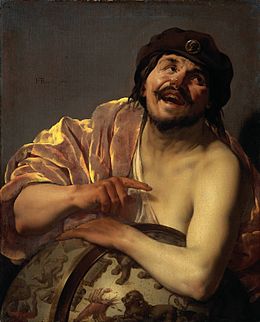
H. ter Brugghen, Democritus (1628)

Thomas Hobbes—arguably the first modern philosopher to offer a deep analysis of the phenomenon—famously defended the first theory. In the Leviathan, he defined laughter as the expression of a sudden glory caused by the comparison between ourselves and those we consider inferior to us in some respect. On the other hand, according to the relief theory championed by Sigmund Freud, laughter is the release of some kind of energy that has built up pressure. In his Der Witz und seine Beziehung zum Unbewußten, Freud argued that laughter unleashes nervous energy that in everyday life is used to repress emotions, to think, or to feel emotions. Finally, the incongruity theory states that we laugh at things that disprove our assumptions in a particular way. In his Kritik der Urteilskraft, Immanuel Kant defended a general version of the incongruity theory, according to which laughter is an effect that arises if a tense expectation is transformed into nothing (Kant specified that it must be nothing and not the positive opposite of the expectation, thus implying that not all that is unexpected is also laughable). Two centuries later, in Le Rire, Henri Bergson presented a more specific version of the incongruity theory. He argued that we laugh when we see something mechanical in something living.

Laughter, however, is not simply one of the many objects of philosophical research. Strong bonds link philosophical research and laughter at a deeper level. Laughter is sometimes used as a defining characteristic of important philosophical figures. Most notably, in one of the letters attributed to Hippocrates, we find a melancholic Democritus who constantly laughs at his fellow citizens because he considers their endeavours completely meaningless. The philosopher laughs at the human condition.

The connection between laughter and philosophy becomes particularly complex when we highlight the similarities between the activity of the philosopher and the comedy writer: both reflect on familiar phenomena; they use critical thought; they step back emotionally from the problem they tackle; and they give us a new outlook on the world.

The goal of this volume of Odradek will be to shape a new and deeper understanding of the phenomenon of laughter, especially in its relation to philosophy; however, we welcome papers from various disciplines.

The topic of the proposals might include, but need not to be restricted to:

  • Laughter, comedy and philosophy in literature
  • Analysis of one or more of the theories of laughter
  • Psychology of laughter
  • Laughter as a social phenomenon
  • Analysis of the figure of the laughing philosopher
  • Analysis of the relationship between comedy and philosophy

Share this:

  • Email a link to a friend (Opens in new window) Email
  • Share on Facebook (Opens in new window) Facebook
  • Print (Opens in new window) Print
  • Share on X (Opens in new window) X
Like Loading...
← Older posts
Newer posts →

Archivio notizie

Menu

  • ADMISSION
  • Una testimonianza per il futuro dopo la tragedia del coronavirus
  • GROUPS
    • Classical German Philosophy and Phenomenology
    • Philosophies of Image and Imagination
    • The Philosophy of Nature
    • The quarrel between philosophy and poetry
    • The quarrel between the ancients and moderns
    • Theories of Emotions
    • Utopia, the Political Myth, and Rebellion
  • CONFERENCES
    • 2019
      • Gli spazi e i tempi della forma: storia naturale delle rovine
    • 2018
      • Sellars e la filosofia post-kantiana
    • 2017
      • Dialettica della ragione, teleologia e idea di mondo in Kant.
      • La filosofia e il tragico
      • La leggibilità della natura
    • 2016
      • Dialectic and the Ends of Reason
        • Schedule
      • Il tragico nella letteratura tedesca
    • 2015
      • Immaginazione e Giudizio In Kant
        • Schedule
      • MELANCOLIA. Metamorfosi dell’umor nero
        • Introduction
        • Schedule
      • THE WISDOM OF THE ANCIENTS. The German-Jewish Revaluation of Ancient Philosophy
        • Introduction
        • Schedule
    • 2014
      • Hegel and the phenomenological movement
  • CONTACTS
  • EVENTS
  • IDEAS
  • ODRADEK Journal
  • PEOPLE
  • PRESS REVIEW
  • RICORDANDO BARALE

Zetesis FanPage

Zetesis FanPage

I nostri eventi

This slideshow requires JavaScript.

Blog at WordPress.com.

Privacy & Cookies: This site uses cookies. By continuing to use this website, you agree to their use.
To find out more, including how to control cookies, see here: Cookie Policy
  • Subscribe Subscribed
    • zetesisproject.com
    • Join 27 other subscribers
    • Already have a WordPress.com account? Log in now.
    • zetesisproject.com
    • Subscribe Subscribed
    • Sign up
    • Log in
    • Report this content
    • View site in Reader
    • Manage subscriptions
    • Collapse this bar
 

Loading Comments...
 

    %d