• Home
  • IDEAS
  • GROUPS
    • Classical German Philosophy and Phenomenology
    • The quarrel between the ancients and moderns
    • The quarrel between philosophy and poetry
    • Theories of Emotions
    • Philosophies of Image and Imagination
    • Utopia, the Political Myth, and Rebellion
    • The Philosophy of Nature
  • EVENTS
  • PEOPLE
  • ADMISSION
  • CONTACTS
  • CONFERENCES
    • 2016
      • Il tragico nella letteratura tedesca
      • Dialectic and the Ends of Reason
        • Schedule
    • 2015
      • CONVEGNO MELANCOLIA
        • Introduction
        • Schedule
      • CONFERENCE ON THE ANCIENTS
        • Introduction
        • Schedule
      • Immaginazione e Giudizio In Kant
        • Schedule
    • 2014
      • Hegel and the phenomenological movement
  • ODRADEK Journal

Monthly Archives: June 2016

“Immaginare l’altrove” Dall’Utopia di Thomas More al Seicento

22 Wednesday Jun 2016

Posted by Stella Ammaturo in suggerimenti eventi

≈ Leave a comment

Tags

Albrecht Durer, anti-utopia, Carlo Altini, Doni, Elisabetta Scapparone, Francesco Pucci, Gennaro Maria Barbuto, Giovanni Maria Fara, Gregorio Piaia, John Milton, Katia Senjic, Luisa Brotto, Machiavelli, Maria Assunta Picardi, Marie-Luce Demonet, Maurizio Cambi, Montaigne, Nicola Panichi, Pasquale Terracciano, Pierre Bayle, Rabelais, Saverio Ricci, Simonetta Bassi, Thomas More, Tommaso Campanella, utopia, Valentina Serio, Zuccolo

Vi segnaliamo il convegno su Immaginare l’altrove organizzato da Valentina Serio nell’ambito del progetto PRA 2015 coordinato dalla prof.ssa Bassi.

L’evento si svolgerà martedì 28 e mercoledì 29 giugno presso la Gipsoteca di Arte Antica in p.zza San Paolo all’Orto.

locandina

Share this:

  • Email a link to a friend (Opens in new window) Email
  • Share on Facebook (Opens in new window) Facebook
  • Print (Opens in new window) Print
  • Share on X (Opens in new window) X
Like Loading...

lectio magistralis: Massimo Barale e la filosofia

21 Tuesday Jun 2016

Posted by Stella Ammaturo in suggerimenti eventi

≈ Leave a comment

Tags

Claudio La Rocca, filosofia, lectio magistralis, Massimo Barale, ricordo, Università di Pisa


Mercoledì 29 giugno 2016
nell’aula Magna del palazzo Matteucci alle ore 16

il prof. Claudio La Rocca

(Università di Genova)

terrà una lectio magistralis su

Massimo Barale e la filosofia

per ricordare la figura di un maestro, collega e amico così importante per la filosofia, per la nostra università, per tutti noi

logo-seminario-filosofia

Share this:

  • Email a link to a friend (Opens in new window) Email
  • Share on Facebook (Opens in new window) Facebook
  • Print (Opens in new window) Print
  • Share on X (Opens in new window) X
Like Loading...

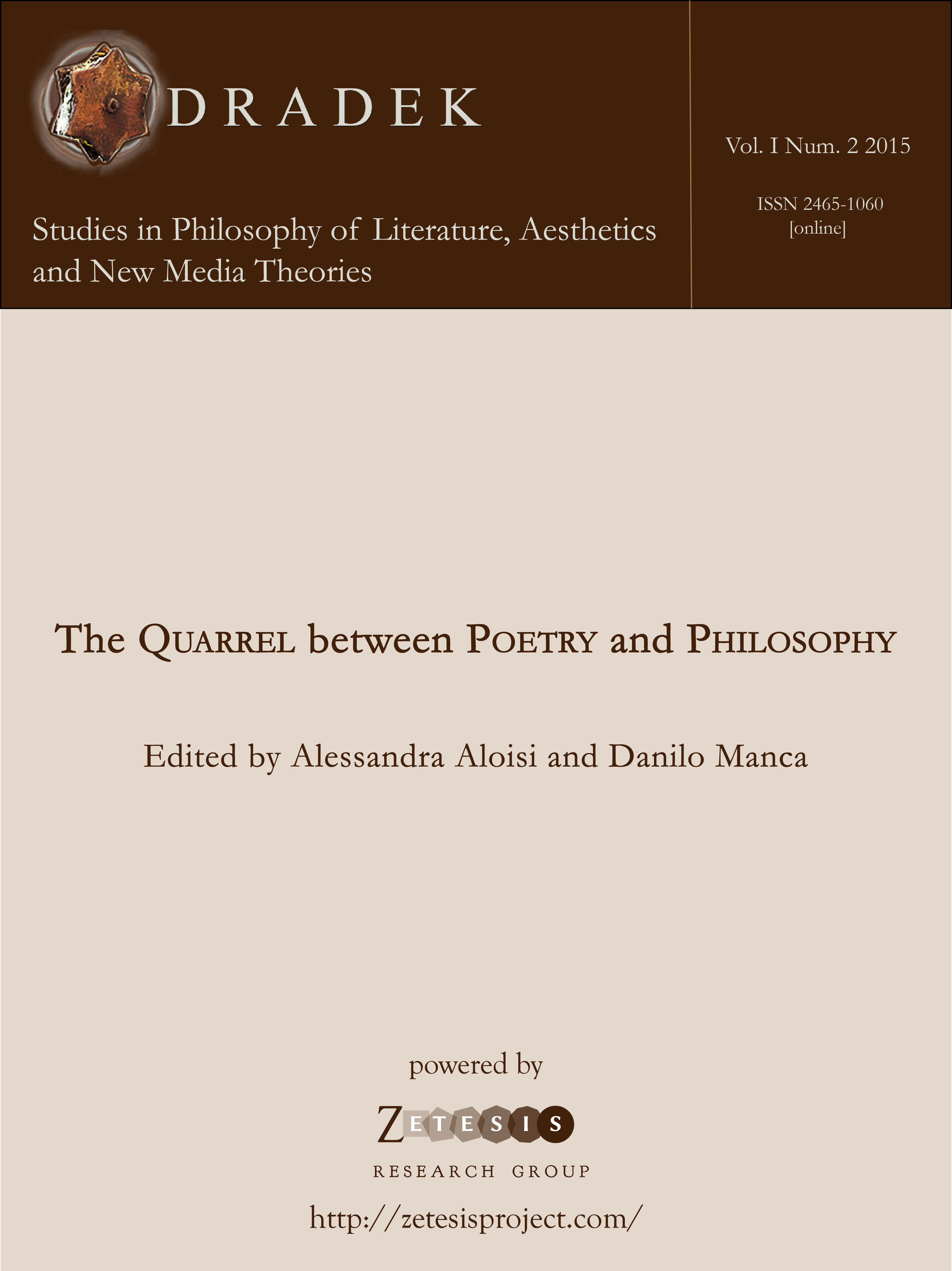
ODRADEK, Vol. I, no. 2: The Quarrel between Poetry and Philosophy

16 Thursday Jun 2016

Posted by Stella Ammaturo in Odradek

≈ Leave a comment

Tags

aesthetics, albert camus, Alessandra Aloisi, Andrew Benjamin, Danilo Manca, David Roochnik, Edoardo Raimondi, Franco D'Intino, Grace Whistler, Leo Strauss, Leopardi, logique de la philosophie, Lorenzo Serini, Marco Menon, Marco Piazza, Nietzsche, novel, Odradek rivista online, Paolo Godani, philosophical self-criticism, Plato, Political Philosophy, quarrel poetry philosophy, reflection, rhetoric, rivista filosofia e letteratura, Walter Benjamin

È con immenso piacere che segnaliamo la pubblicazione del secondo numero della nostra rivista online Odradek sul tema

The Quarrel between Poetry and Philosophy


Di seguito trovate l’indice degli articoli con il link diretto alla pagina della rivista.

Vol I, no 2 (2015):
The Quarrel between Poetry and Philosophy,quarrel-poetry-phil-ct
edited by Alessandra Aloisi and Danilo Manca

Table of contents

Introduction
Alessandra Aloisi and Danilo Manca


The Quarrel between poetry and philosophy Poetry as Philosophical Self-Criticism
David Roochnik

Leopardi and Plato (Drama and Poetry vs Philosophy)
Franco D’Intino

Furor Divinus: Creatuvity in Plato’s Ion
Andrew Benjamin

From Rhetoric to Reflection: Albert Camus and the «Ancient Quarrel»
Grace Whistler

Where Philosophy Meets Poetry in Nietzsche’s Writings from 1872-1873
Lorenzo Serini

An Unpolitical Political Philosophy? Some Remarks on Leo Strauss’ «Notes on Lucretius»
Marco Menon

Poesia e Filosofia nella Logique de la Philosophie
Edoardo Raimondi

The Individual between Aesthetics and the Novel
Paolo Godani

Walter Benjamin tra redenzione e rammemorazione, via Proust
Marco Piazza

Share this:

  • Email a link to a friend (Opens in new window) Email
  • Share on Facebook (Opens in new window) Facebook
  • Print (Opens in new window) Print
  • Share on X (Opens in new window) X
Like Loading...

Giornata di studi “Lo statuto della coscienza: Fenomenologia e Filosofia della mente”

14 Tuesday Jun 2016

Posted by Stella Ammaturo in incontri, suggerimenti eventi

≈ Leave a comment

Tags

Alessandra Fussi, coscienza, Danilo Manca, dottorato in filosofia, esperienza dolore, esperienza soggettiva, fenomenologia, Filieri, Filippo Nobili, filosofia, filosofia della mente, giornata di studi, Giovambattista Bonfiglio, Husserl, Luca Vanzago, Luigi, materialismo, Roberta Lanfredini, Rodolfo Giorgi, scienze empiriche, Silvano Zipoli-Caiani, Stefano Poggi, Università di Firenze, Università di Pisa, Valeria Bizzari

Vi segnaliamo la giornata di studi organizzata dal Dottorato in Filosofia
delle Università di Pisa-Firenze sul tema

Lo statuto della coscienza:
Fenomenologia e Filosofia della mente

l’evento si terrà martedì 21 giugno 2016 a Firenze presso la Sala Conferenze del Dipartimento di Filosofia in via Bolognese, n. 52

Programma della giornata

9:00 Presentazione

9:15 Rodolfo Giorgi (Università di Pisa)
L’esperienza soggettiva: il problema dei qualia

9:45 Silvano Zipoli-Caiani (Università di Firenze)
Quando le affordance spariscono. Due modelli della spiegazione a confronto

10:15 -DISCUSSIONE-

10:45 Break

11:00 Giovambattista Bonfiglio (Università di Pisa)
Materialismo e coscienza

11:30 Luca Vanzago (Università di Pavia)
L’esperienza del dolore: modelli concettuali a confronto

12:00 -DISCUSSIONE-

12:30 Pausa pranzo

_____________________________________________________________________

15:00 Filippo Nobili (Università di Pisa-Firenze)
Genesi della coscienza e conoscenza della genesi: Husserl e la filosofia della mente

15:30 Danilo Manca (Università di Pisa)
La trama della coscienza. Sul modello emergentista della fenomenologia

16:00 Valeria Bizzari (Università di Pisa)
Il problema della coscienza: naturalizzare la fenomenologia o fenomenologizzare le scienze empiriche?

16:30 -DISCUSSIONE-

17:00 Fine lavori

Download programma

COMITATO SCIENTIFICO – ORGANIZZATIVO:
Prof. Stefano Poggi, Prof.ssa Roberta Lanfredini, Prof.ssa Alessandra Fussi, Dott. Luigi Filieri

Share this:

  • Email a link to a friend (Opens in new window) Email
  • Share on Facebook (Opens in new window) Facebook
  • Print (Opens in new window) Print
  • Share on X (Opens in new window) X
Like Loading...

CFP Emotion and Cognition

03 Friday Jun 2016

Posted by Danilo Manca in CFA-CFP

≈ Leave a comment

Tags

Andrea Lavazza, behavioral economics, cognition, emotion, Hume, Kant, moral emotion, morality, neuroeconomics, neuroethics, passion, pathology, philosophy, psychology, Rivista Filosofia e Psicologia

Segnaliamo con piacere il seguente call for papers della RiFP – Rivista internazionale di Filosofia e Psicologia:


Emotions and Cognition: Philosophy, Psychology, and Neuroscience in Dialogue


What is an emotion? What is the relationship between emotion and cognition? How can one best articulate the distinction, if there is one, between cognition and emotion? What is the function of emotion with respect to cognition? And what contribution can neuroscience make to our understanding of emotions and the relationship between cognition and emotion? These are just a few of the key questions addressed by those philosophers, psychologists and neuroscientists who investigate emotional experience.

RiFP – Rivista internazionale di Filosofia e Psicologia, with the support of SINe – Società italiana di Neuroetica e Filosofia delle Neuroscienze, seeks to promote a broad interdisciplinary discussion on these themes for the first issue in 2017. RIFP and SINe invite all scholars who wish to contribute to this discussion to send original manuscripts on the relationship between emotion and cognition, from a theoretical and/or empirical and/or historical approach. The sub-themes of the present call for papers include, but are not limited to:


(a) work that focuses, including from a historical perspective, on the relationship between emotions and knowledge, by defining the possible differences between, or identity of, emotional experiences and cognitive processes. The relationship between emotion and reason has a complex and well-articulated history that has developed around two main perspectives: a Humean perspective that assigns an important role to the “passions”, and a Kantian perspective that, in contrast, downplays the emotions privileging the role of “disembodied” thought. That the emotions play a fundamental role in psychic life and mental processes no matter how the latter are defined, is today considered beyond doubt. Contemporary discussion instead focusses on the nature of the relationship between emotions and cognition in various circumstances. We are especially interested in contributions which provide a diachronic perspective on contemporary research, pointing out blind spots and dead ends in the debate to date, and indicating which avenues of research have the most potential for elucidating our understanding of the interactions between emotion and cognition. We will also welcome contributions that present the most influential contemporary proposals, outlining their strengths and weaknesses in order to provide a taxonomy that helps to map out the current discussion.


(b) work that considers the role of emotions in the genesis and interpretation of psychological “pathology”, explicating which conditions should in fact be defined as “pathological” and which might instead be reinterpreted and re-categorized  (as “normalcy”, “anomaly”, “different cognitive style”). In particular, we welcome contributions which offer new interpretive perspectives on emotional dysfunction and the various kinds of therapeutic modalities for the treatment of dysfunction.


(c) work that explores neurophysiological aspects of emotional experiences, focusing on the central role of the limbic system in producing the emotional experience that structures the behavior of the individual. Both from a neurobiological and a theoretical-interpretative point of view, the properties of the limbic system have received increasing attention leading to modifications in descriptions of this system in current research. Contributions that provide up to date information on current research and debates in this area are especially welcome.


(d) work investigating the connection between morals and emotions, focusing in particular on the links between research in ethics and cognitive neuroscience, which demonstrate that both descriptive and normative theories can and must (or, vice versa, cannot and must not) take into consideration and incorporate  new findings related to the role of brain functions in judgements and behaviors.


(e) work in behavioral economics and neuroeconomics that highlights the complementary and/or antagonistic role(s) of emotion and cognition in decision making. Only several decades ago, economics, considered as an autonomous discipline, tended to reduce decision making to a function based on the simple maximization of individual utility.


Manuscript preparation and submission

Manuscripts should not exceed 9,000 words (including footnotes) and must be submitted through the online submission procedure available on the journal internet site by September 30th, 2016.

Manuscripts written in Italian or English will be considered for publication. An English abstract of max. 150 words and 5 English key-words must be provided. Please, insert the code “Emotion&Cognition2016” in the box “Communications to the Editor” in the online submission form (step 1). Two separate documents should be submitted. The first document must be anonymous and contain only the manuscript and abstract without any identifying information about the author(s). A second document (called “supplementary file”) must be submitted separately (step 3) and include pictures, tabs, title, abstract, the whole manuscript as well as author(s)’ name, affiliation, e-mail, and surface postal address.

After a preliminary assessment by the Editorial Board, submissions undergo a double–blind peer review process. For instructions on how to prepare the manuscript, click on the link “How to ensure a blind review” available on the internet site. The decision will be communicated to the authors within 6 weeks after submission. After manuscript acceptance, an authors’ guideline will be provided to copyedit the final version of the manuscripts.

For further information please email Andrea Lavazza: lavazza67@gmail.com

Share this:

  • Email a link to a friend (Opens in new window) Email
  • Share on Facebook (Opens in new window) Facebook
  • Print (Opens in new window) Print
  • Share on X (Opens in new window) X
Like Loading...

Archivio notizie

Menu

  • ADMISSION
  • Una testimonianza per il futuro dopo la tragedia del coronavirus
  • GROUPS
    • Classical German Philosophy and Phenomenology
    • Philosophies of Image and Imagination
    • The Philosophy of Nature
    • The quarrel between philosophy and poetry
    • The quarrel between the ancients and moderns
    • Theories of Emotions
    • Utopia, the Political Myth, and Rebellion
  • CONFERENCES
    • 2019
      • Gli spazi e i tempi della forma: storia naturale delle rovine
    • 2018
      • Sellars e la filosofia post-kantiana
    • 2017
      • Dialettica della ragione, teleologia e idea di mondo in Kant.
      • La filosofia e il tragico
      • La leggibilità della natura
    • 2016
      • Dialectic and the Ends of Reason
        • Schedule
      • Il tragico nella letteratura tedesca
    • 2015
      • Immaginazione e Giudizio In Kant
        • Schedule
      • MELANCOLIA. Metamorfosi dell’umor nero
        • Introduction
        • Schedule
      • THE WISDOM OF THE ANCIENTS. The German-Jewish Revaluation of Ancient Philosophy
        • Introduction
        • Schedule
    • 2014
      • Hegel and the phenomenological movement
  • CONTACTS
  • EVENTS
  • IDEAS
  • ODRADEK Journal
  • PEOPLE
  • PRESS REVIEW
  • RICORDANDO BARALE

Zetesis FanPage

Zetesis FanPage

I nostri eventi

This slideshow requires JavaScript.

Create a free website or blog at WordPress.com.

Privacy & Cookies: This site uses cookies. By continuing to use this website, you agree to their use.
To find out more, including how to control cookies, see here: Cookie Policy
  • Subscribe Subscribed
    • zetesisproject.com
    • Join 27 other subscribers
    • Already have a WordPress.com account? Log in now.
    • zetesisproject.com
    • Subscribe Subscribed
    • Sign up
    • Log in
    • Report this content
    • View site in Reader
    • Manage subscriptions
    • Collapse this bar
 

Loading Comments...
 

    %d